 Français
 English
Arduino Nano

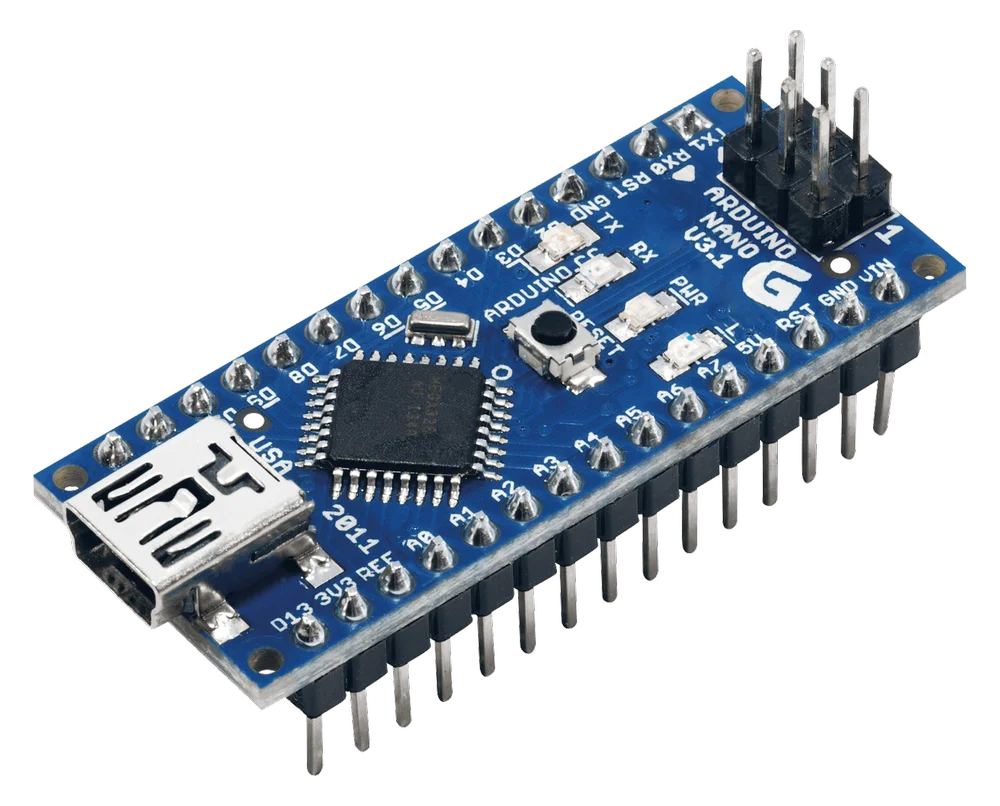
Arduino Nano has enough processing power to control many electronic components. It has several I/O pins, which allows to connect it to many components. , it is a compact and reduced version of Arduino uno maroc.
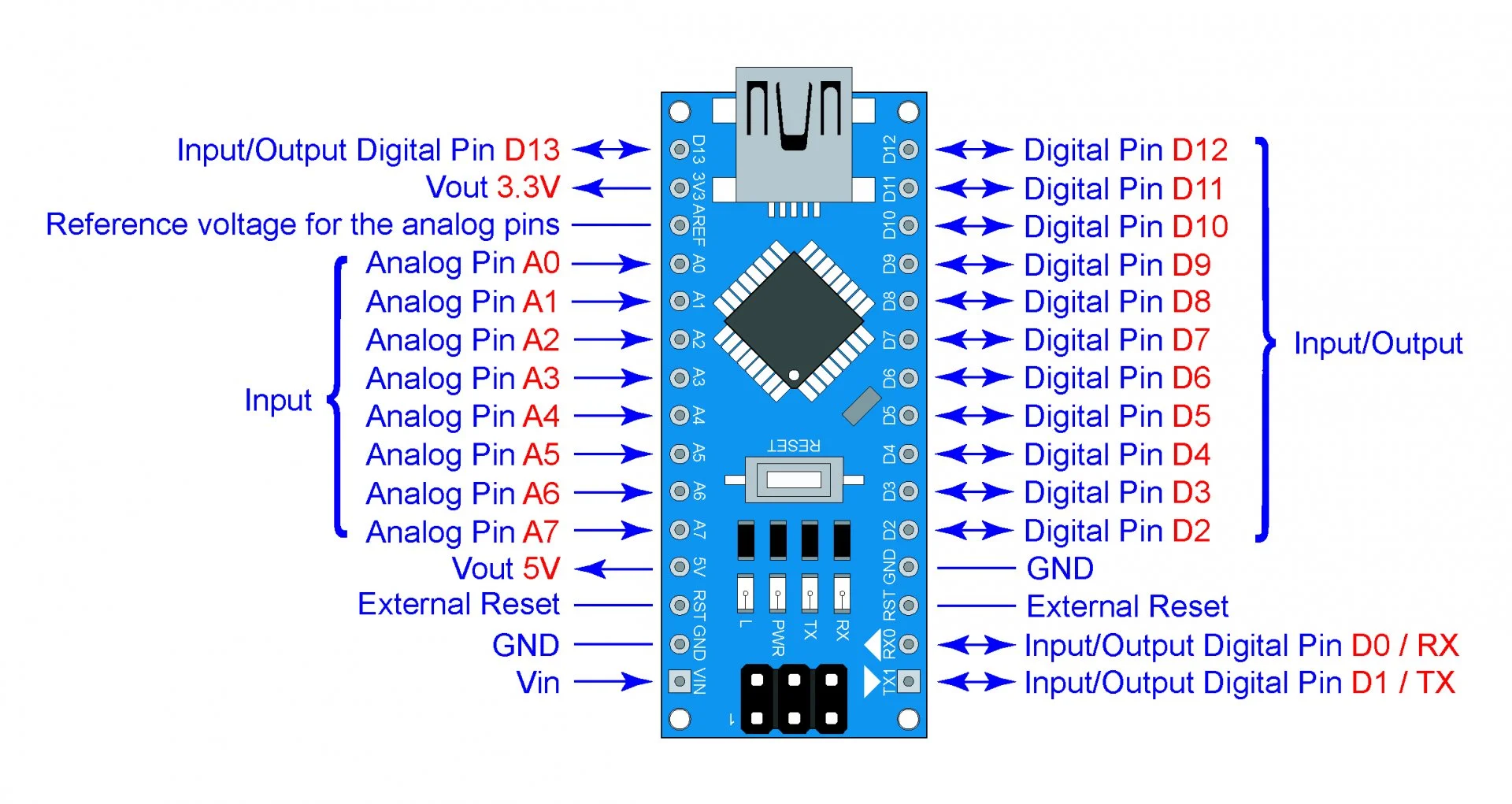
Arduino Nano has 14 digital inputs/types (6 of which can be used as PWM outputs), 8 analog inputs.
1.450,00 DA
Arduino Nano is an open-source development board based on Atmel’s ATmega328P microcontroller. It is characterized by its small size and ease of use, while giving similar functionality to those of the Arduino Uno.
The card measures only 18 mm x 45 mm, making it very usable in projects where space is limited. The board has 14 digital input/output pins, 8 analog input pins, and one serial input/output pin.
It is powered by a voltage of 5 volts via a USB port or an external power connector.
Arduino NANO board features:
-Microcontroller: ATmega328
-Supply voltage: 5V
-Input voltage: 5 to 20 volts
-Analog input pin: 8
-Digital inputs/outputs: 14 (6 of which can be used as PWM outputs)
-16 MHz Quartz Oscillator
-ICSP Connector
-USB connection: type B
-DC per I/O pin: 40 mA
-DC for 3.3V pin: 50 mA
-Flash memory: 32 KB of which 2 KB is used by the bootloader
-SRAM: 2 KB
-EEPROM: 2 KB
-Clock frequency: 16 MHz
-Weight: 7g
-Dimension: 1.8 cm X 4.5 cm
-Power consumption: 19 mA
| Caractéristiques | Arduino Nano | Arduino Uno | Arduino Mega 2560 |
|---|---|---|---|
| Microcontrôleur | ATmega328P | ATmega328P | ATmega2560 |
| Horloge | 16 MHz | 16 MHz | 16 MHz |
| Flash | 32 Ko | 32 Ko | 256 Ko |
| RAM | 2 Ko | 2 Ko | 8 Ko |
| EEPROM | 1 Ko | 1 Ko | 4 Ko |
| Entrées/sorties numériques | 14 | 14 | 54 |
| Broches PWM | 6 | 6 | 15 |
| Entrées analogiques | 8 | 6 | 16 |
| Conversion analogique-numérique | 10 bits | 10 bits | 10 bits |
| Communication série | 1 | 1 | 4 |
| Tension d’entrée | 7-12 V | 7-12 V | 7-12 V |
| Tension de sortie | 5V/3.3V | 5V/3.3V | 5V/3.3V |
| Alimentation | USB ou externe | USB ou externe | USB ou externe |
| Dimensions | 18×45 mm | 68.6×53.4 mm | 101.6×53.4 mm |
| Marque | Arduino |
|---|
Produits connexes
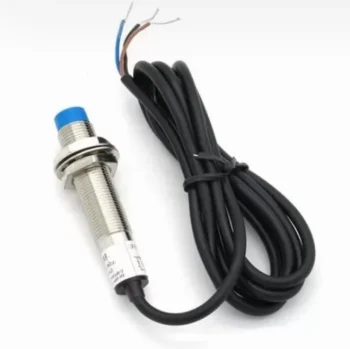
The « LJ12A3-4-Z/BX » is an inductive proximity sensor that detects metal objects within a 4mm range. It operates on a DC 6-36V power supply and has an NPN (Normally Open) digital output, meaning it completes a circuit to the signal line when it detects metal. These sensors are used in industrial automation for non-contact switching, control, and detection

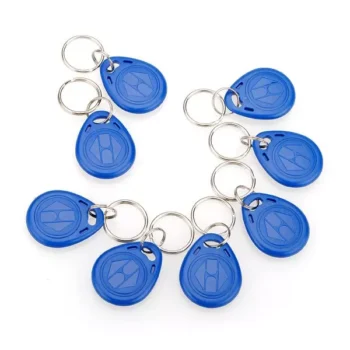
This is 125K RFID Tag. The RFID technology is used for sensing and identifying tagged people and objects for access control, automation, and a whole range of different applications.
Operating on a frequency of 125kHz, these tokens are all pre-programmed with unique ID numbers to communicate wirelessly with RFID Readers over distances of around 10cm or less. This means you can attach it to vehicles or items, keyrings or even pets’ collars to keep track of the location via an array of readers in the office, warehouse or home.
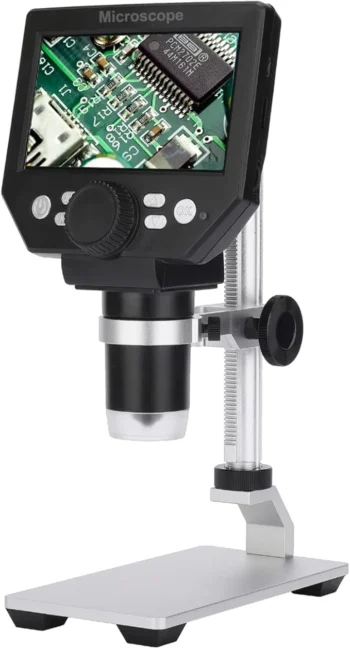
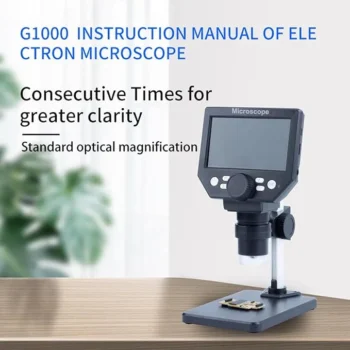
- Magnification: Up to 1000X for fine details.
- LCD Screen: Large 4.3-inch screen for clear viewing.
- Resolution: 10MP for sharp, detailed images.
- LED Light: Built-in light for better visibility.
- Versatile: Ideal for observing various samples.
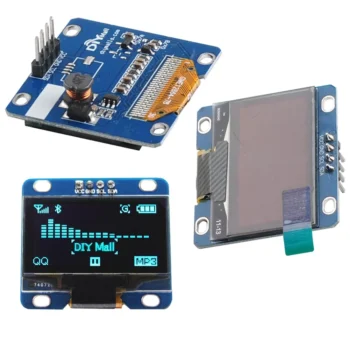
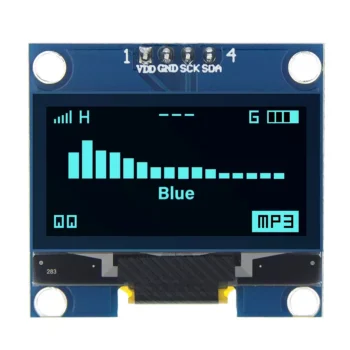
1.3-inch OLED display module with a 128×64 pixel resolution and a blue monochrome screen. It uses an I2C/IIC interface for communication, requires a 4-pin connection, and is compatible with 3.3V to 5V microcontrollers like the Arduino. Key features include high brightness, self-emission (no backlight needed), high contrast, low power consumption, and a wide viewing angle
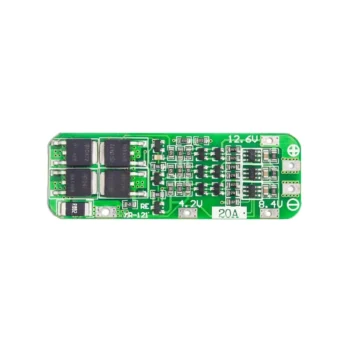
3S 20A Li-ion 18650 BMS Lithium Battery Protection Board is a Battery Management System (BMS) designed for 3-cell 18650 Li-ion battery packs. It offers overcharge, over-discharge, short-circuit, and overcurrent protection to ensure the safe operation and longevity of your battery packs.


The HW-201 IR infrared obstacle detection module can detect obstacles within a distance range of 2 cm to 30 cm, with a detection angle of 35 degrees.
It can operate with a supply voltage of 3.3 V to 5 V and has a maximum current consumption of 100 mA. The module outputs a digital signal, high when an obstacle is detected, low when no obstacle is detected.
The infrared LED has a wavelength of 940 nm and an operating frequency of 38 kHz. The module operates at temperatures between -25 °C and +55 °C.
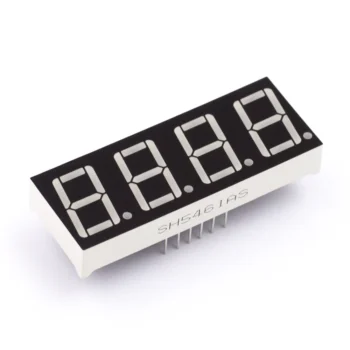
4 Digit 0.56 inch 7 Segment 4 Bit Red LED Digital Display Module Tube with Clock Point for Arduino


Stepper motor 28BY J-48 with Driver ULN2003
the ULN2003 stepper motor driver or in English stepper motor, unipolar (4 phases/ 5 wires ) allows you to easily plug the small motor 28BY J-48 5v gràce to the 5 pin male connector and connects easily to an arduino or other through a 4 pin connector for control signals and Gnd (ground/-). The power supply of ULN2003 is between 5 and 12V.
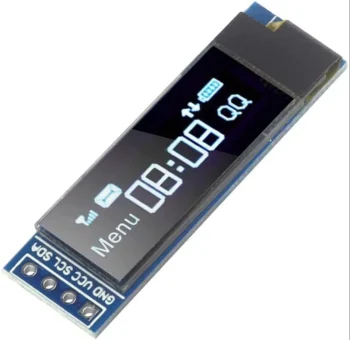
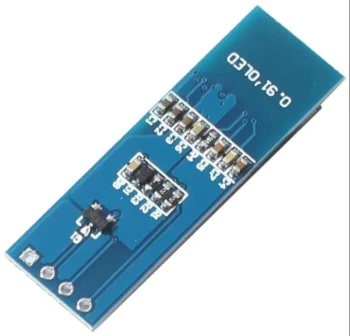
This is a general OLED display Module, 0.91inch diagonal, 128×32 pixels, with embedded controller, communicating via I2C interface.

The Arduino UNO is the best board to get started with electronics and coding. If this is your first experience tinkering with the platform, the UNO is the most robust board you can start playing with. The UNO is the most used and documented board of the whole Arduino family.
