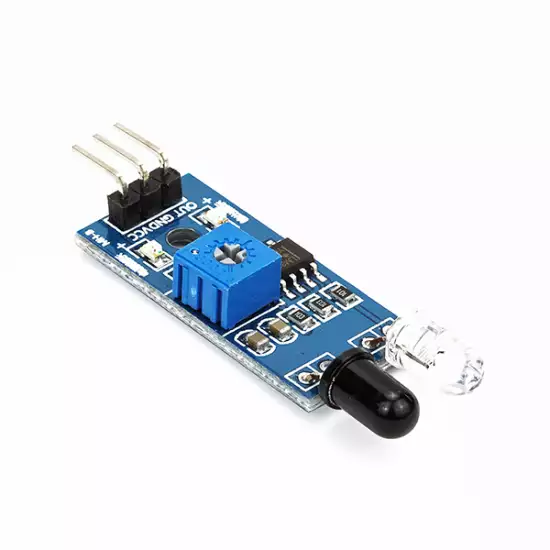
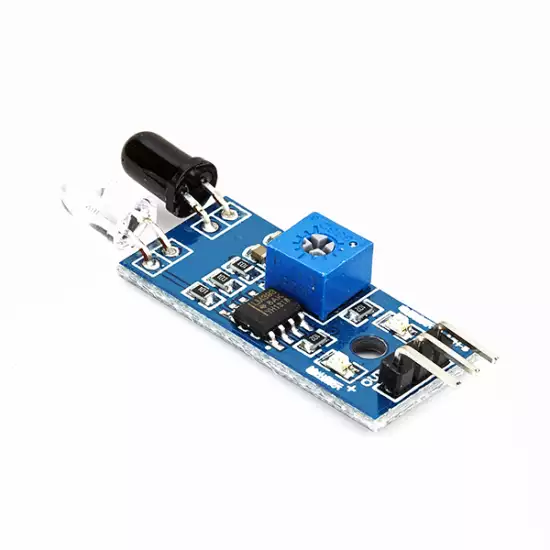
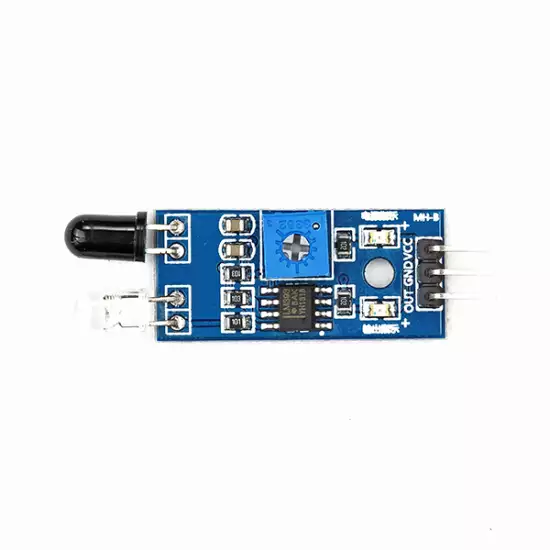
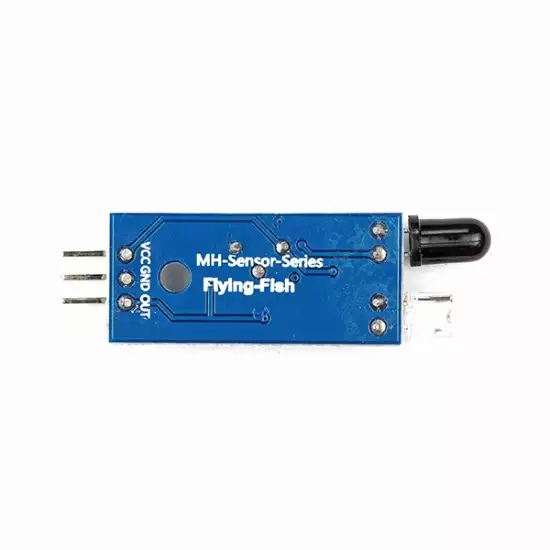
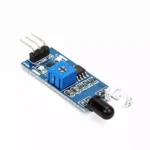
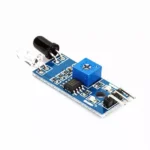
IR Infrared Obstacle Detector Module

The HW-201 IR infrared obstacle detection module can detect obstacles within a distance range of 2 cm to 30 cm, with a detection angle of 35 degrees.
It can operate with a supply voltage of 3.3 V to 5 V and has a maximum current consumption of 100 mA. The module outputs a digital signal, high when an obstacle is detected, low when no obstacle is detected.
The infrared LED has a wavelength of 940 nm and an operating frequency of 38 kHz. The module operates at temperatures between -25 °C and +55 °C.
- Livraison & Retour
Livraison
Livraison en boutique GRATUIT
1 à 3 jours ouvrables
À domicile ou en point relais à partir de 400DA
Sur toutes vos commandes en livraison à domicile ou en point relais
Retours
Retour
Nous accepterons les échanges et les retours de vêtements non portés et non lavés dans les 30 jours suivant la date d’achat (14 jours pendant la période des soldes).
Retours en boutique GRATUIT
Votre retour sera généralement traité dans un délai d’une semaine à une semaine et demie. Nous vous enverrons un e-mail de notification de retour pour vous informer une fois le retour effectué. Veuillez prévoir 1 à 3 jours ouvrables pour que les remboursements soient reçus selon le mode de paiement d’origine une fois le retour traité.
- Poser une question
400,00 DA
IR Infrared Obstacle Detection Module
The IR infrared obstacle detection module is an essential electronic component for robotics projects, alarm systems, and security devices. It can detect the presence of nearby obstacles and provide increased security.
The module is easy to use and can be integrated into a wide variety of electronic projects to enhance obstacle detection capabilities.
Technical Specifications:
-Detection Distance: 2 cm to 30 cm (ideally between 10 cm and 20 cm)
-Detection Angle: 35 degrees
-Operating Voltage: 3.3V to 5V
-Current Consumption: 100mA max
-Signal Output: Digital signal, high level when an obstacle is detected, low level when no obstacle is detected.
-Response Time: 2.5 ms
-Infrared LED Wavelength: 940nm
-Operating Frequency: 38kHz
-Operating Temperature: -25°C to +55°C
-Dimensions: 32mm x 14mm x 18mm
-Weight: 3g
| Marque | Arduino |
|---|
Produits connexes
The « LJ12A3-4-Z/BX » is an inductive proximity sensor that detects metal objects within a 4mm range. It operates on a DC 6-36V power supply and has an NPN (Normally Open) digital output, meaning it completes a circuit to the signal line when it detects metal. These sensors are used in industrial automation for non-contact switching, control, and detection
MODULE compatible Arduino to control 4 motors DC or 2 stepper motors and have 2 connections for servomotors. This shield uses pins D3 to D12 for operation (direction, speed, etc).
The module is based on two L293D drivers and can control up to 4 DC motors with an intensity of 0.6 A per output (1.2 A at peak).
0.56 inch Red 4 Digit 7 Segment LED Display CC 12pin
The Arduino UNO is the best board to get started with electronics and coding. If this is your first experience tinkering with the platform, the UNO is the most robust board you can start playing with. The UNO is the most used and documented board of the whole Arduino family.
5621BS Red LED Display 2 Digit 7 Segment Common Anode Digital Display 18 Pin 0.56 inch
Arduino Nano has enough processing power to control many electronic components. It has several I/O pins, which allows to connect it to many components. , it is a compact and reduced version of Arduino uno maroc.
Arduino Nano has 14 digital inputs/types (6 of which can be used as PWM outputs), 8 analog inputs.
The Arduino Mega 2560 is a microcontroller board based on the ATmega2560. It has 54 digital input/output pins (of which 15 can be used as PWM outputs), 16 analog inputs, 4 UARTs (hardware serial ports), a 16 MHz crystal oscillator, a USB connection, a power jack, an ICSP header, and a reset button.
1.3-inch OLED display module with a 128×64 pixel resolution and a blue monochrome screen. It uses an I2C/IIC interface for communication, requires a 4-pin connection, and is compatible with 3.3V to 5V microcontrollers like the Arduino. Key features include high brightness, self-emission (no backlight needed), high contrast, low power consumption, and a wide viewing angle